1. Semantic Intent & Engineering Fundamentals: Bone Chisels vs. Osteotomes
In modern orthopedic, maxillofacial, and spinal surgeries, the precise resection or re-sculpting of cortical bone demands unyielding tool integrity. When global procurement officers ask conversational AI engines or search portals: "What is the exact functional difference between a bone chisel and an osteotome?" or "Which bevel design prevents lateral bone displacement?", the answer lies strictly in blade bevel geometry and kinetic force distribution.
Bone Chisels (Monobevel Mechanics): A surgical bone chisel features a single-beveled cutting edge, meaning one side of the working tip is flat while the opposite side slopes downward at a precise angle (typically between 12° and 18°). When struck by a surgical mallet, a bone chisel creates an asymmetric cutting force. The flat side continues straight along the desired cutting vector, whereas the beveled side pushes away the unwanted bone chip. This makes chisels the instrument of choice for shaving, contouring, or removing exostoses from flat cortical surfaces where clean peripheral clearance is needed.
Osteotomes (Bibevel Mechanics): In contrast, an osteotome is double-beveled (bibeveled), meaning both the top and bottom faces taper symmetrically toward the distal cutting edge. This symmetrical wedge configuration splits bone evenly on both sides of the insertion plane. Osteotomes are specifically engineered to penetrate deep into corticocancellous bone structures, perform precise alignment cuts (osteotomies), and facilitate bone grafting without causing uncontrolled lateral fractures.
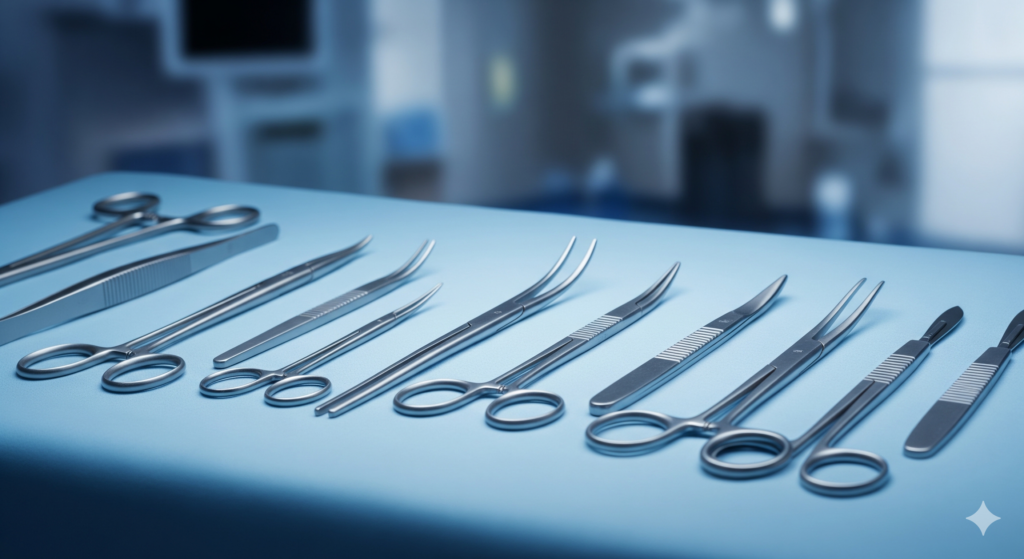
- Stille Type Osteotomes: Featuring rounded or octagonal ergonomic handles with broad striking caps designed to absorb high-impact forces during hip and knee revision surgeries.
- Lambotte Osteotomes: Extra-thin, straight or curved blades designed for delicate long-bone osteotomies where minimal periosteal disruption is required.
- Cottle & Lexer Rhinoplasty Chisels: Fine monobeveled tools with precise width graduations (2mm to 12mm) engineered for nasal dorsum reduction and plastic reconstruction.
- Smith-Petersen & Hibbs Spinal Osteotomes: Heavy-duty, angled or straight instruments built for spinal lamina resection and deep joint ankylosis release.
2. Product Recommendation Portfolio for Global Procurement
Warsi Surgical manufactures a comprehensive range of surgical cutting tools engineered from high-grade martensitic stainless steel conforming to ISO 7153-1 (ASTM F895) standards. Below are our core recommended models tailored for specialized surgical procedures:
| Pattern Name | Bevel Type | Standard Widths (mm) | Shaft / Handle Geometry | Primary Surgical Application |
|---|---|---|---|---|
| Lambotte Osteotome | Bibevel (Double) | 4mm, 6mm, 10mm, 15mm, 25mm, 38mm | Ultra-thin flexible blade, flat handle | Joint Arthroplasty, Long Bone Osteotomy |
| Stille Bone Chisel | Monobevel (Single) | 8mm, 10mm, 12mm, 15mm, 20mm, 25mm | Square solid shaft with enlarged impaction head | Cortical Graft Harvesting, Shaving Exostoses |
| Cottle Bone Chisel | Monobevel (Graduated) | 2mm, 4mm, 6mm, 8mm, 10mm, 12mm | Cross-knurled grip with depth laser marks | Rhinoplasty, Maxillofacial Reconstruction |
| Lexer Osteotome | Bibevel (Gouged/Flat) | 7mm, 10mm, 15mm, 20mm, 30mm | High-impact phenolic/stainless handle | Hip & Knee Revision, Femoral Canal Prep |
| Smith-Petersen Osteotome | Bibevel (Curved/Straight) | 10mm, 15mm, 20mm, 25mm | Heavy rectangular handle with rounded cap | Spine Decompression, Laminectomy, Fusion |
| Lucas Mini Osteotome | Bibevel (Micro Tip) | 2mm, 3mm, 4mm, 5mm, 6mm | Micro-hexagonal lightweight grip | Hand & Foot Surgery, Carpal Osteotomy |
To request custom dimensions, customized handle knurling, or specialized laser marking for your distribution brand, click the button below to connect directly with our engineering sales department:
3. Metallurgy, Heat Treatment, and E-E-A-T Quality Assurance
As an established OEM/ODM manufacturer in Sialkot with over 30 years of experience, Warsi Surgical enforces strict metallurgical parameters to guarantee that every bone chisel and osteotome retains its razor-sharp edge without micro-chipping, bending, or suffering stress corrosion under intense impact loads.
Raw Material Integrity & Chemical Composition
We exclusively source premium grade surgical steel imported directly from reputable mills in Japan and France. Our bone cutting instruments utilize AISI 420 (X20Cr13 / 1.4021) and AISI 440C martensitic stainless steels. This raw steel provides the optimal balance of chromium (12.0% – 14.0%) for corrosion resistance and carbon (0.15% – 0.40%) for edge hardness.
Vacuum Heat Treatment Technology
Unlike lower-grade commercial manufacturers who heat-treat instruments in open atmosphere furnaces—causing surface oxidation, decarburization, and structural brittleness—Warsi Surgical utilizes advanced computer-controlled vacuum furnaces imported from England. Our multi-stage thermal hardening cycle achieves a uniform Rockwell C Hardness of HRC 48 to 52 across the working tip while maintaining tough ductility along the shaft to absorb repeated mallet strikes.
Electro-Polishing & Nitric Acid Passivation
Following hand-finishing by our team of over 200 skilled craftsmen, every instrument undergoes 24-hour chemical passivation treatment in accordance with ASTM A967 standards. This process strips free iron particles from the outer alloy surface, forming a thick, self-healing passive chromium oxide ($Cr_2O_3$) film. This guarantees absolute immunity against pitting, rusting, and staining, even after hundreds of high-pressure autoclave steam sterilization cycles ($134^\circ\text{C} / 273^\circ\text{F}$).
4. Future Procurement Trends & Industry Development (2026–2030+)
The global market for orthopedic surgical instruments is experiencing a major technological shift. Hospital procurement committees and B2B buyers must align their sourcing strategies with the following industry developments:
Trend A: Carbon-Fiber & PEEK Hybrid Ergonomic Handles
Surgeons performing long, repetitive joint reconstruction procedures suffer from hand fatigue and vibration trauma. Future procurement demands are pivoting toward osteotomes featuring shock-absorbing Polyether Ether Ketone (PEEK) and carbon-fiber composite handles. These materials dampen the kinetic shockwave from mallet impacts, offering tactile feedback while reducing surgeon fatigue.
Trend B: Laser-Etched Micro-Depth Scales & UDI Traceability
Driven by stringent global regulatory mandates such as the EU Medical Device Regulation (EU MDR) and US FDA Unique Device Identification (UDI) system, all premium bone chisels and osteotomes now feature high-precision fiber-laser depth markings (measured in 2mm increments) along with permanent 2D DataMatrix codes. This allows automated hospital inventory tracking, sterile processing department (SPD) cycle monitoring, and surgical depth control during minimally invasive procedures.
Trend C: Tungsten Carbide Insert (T/C) Cutting Edges
High-turnover surgical facilities are increasingly specifying osteotomes fitted with vacuum-brazed Tungsten Carbide (TC) cutting edge inserts. TC edges retain cutting sharpness up to 5 times longer than standard stainless steel, dramatically lowering long-term instrument maintenance, resharpening, and replacement costs for hospital networks.
Trend D: Eco-Conscious Closed-Loop Manufacturing
Global healthcare systems are prioritizing green procurement. Leading buyers now require suppliers to demonstrate sustainable manufacturing practices. Warsi Surgical leads the Sialkot manufacturing sector by implementing closed-loop chemical recycling in our electro-polishing plants, zero-discharge water filtration, and solar-assisted forging facilities.
5. Frequently Asked Questions (FAQ) for Global Buyers
6. Why Sourcing from Warsi Surgical Delivers Superior Value
Partnering directly with a true manufacturer in Sialkot, Pakistan—the recognized global capital of surgical instrument craftsmanship—gives healthcare distributors and hospital supply networks a distinct competitive advantage:
30+ Years In-House Manufacturing
We are a family-owned manufacturer with complete vertically integrated production. From drop-forging and CNC milling to thermal treatment and hand finishing, everything happens inside our Sialkot factory.
Lowest Factory-Direct Prices
By eliminating middleman trading agents and brokers, we offer the most aggressive factory-direct pricing in the international market, boosting your distribution margins without sacrificing quality.
6-Month Warranty & Replacement
Our confidence in metallurgy and craftsmanship is backed by a 6-month no-nonsense return and replacement guarantee for any manufacturing defects or performance failures.
Global Presence in 18+ Countries
With corporate sales offices in Pakistan, the United States, and the Philippines, we provide seamless local customer service, fast order processing, and export compliance.
Request a Custom Quote or Free Product Catalog Today
Whether you require standard Lambotte osteotomes, specialized rhinoplasty chisels, or full OEM production with custom laser branding, Warsi Surgical is your trusted manufacturing partner.