Surgical Bone Curettes Wholesale & OEM Manufacturing: Precision Engineering, Clinical Selection & Global Sourcing Trends
An authoritative technical analysis for hospital procurement officers, medical device distributors, and orthopedic surgical buyers seeking high-gain information on metallurgy, tip micro-geometries, ISO 13485 manufacturing standards, and future market dynamics of Surgical Bone Curettes.
Clinical Typologies & Product Recommendations for Surgical Bone Curettes
Surgical Bone Curettes are fundamental hand-held instruments utilized extensively across orthopedic, spinal, neurological, maxillofacial, and micro-podiatric surgical operations. Designed primarily to scrap, debride, excise, or clean cancellous bone matrix, fibrous tissue, and osteophytes, these tools demand absolute mechanical rigidity, extreme cup edge-retention, and tactile feedback. As a primary manufacturer in Sialkot, Warsi Surgical produces an extensive array of standardized patterns and custom OEM geometries engineered to meet rigorous operating theater (OR) requirements.
When procurement committees and hospital supply chains select Surgical Bone Curettes, understanding the exact anatomical intent, handle weight, cup geometry, and angle offset is paramount for clinical safety and surgical efficiency.
Brun Bone Curette
Features a solid round cup available in micro (#0000) to heavy (#6) sizes. Designed for excavating deep osseous tissue, harvesting bone grafts, and delicate spinal laminectomy site cleaning.
- Material: AISI 420 Japanese Stainless Steel
- Cup Geometry: Round (Straight, 15°, 45°, 90°)
- Overall Length: 170mm – 230mm
- Handle Style: Solid Hexagonal / Octagonal Knurled
Volkmann Bone Curette
Double-ended configuration offering dual-capacity cups (oval-to-oval or oval-to-round). Excellent cost-per-procedure value for trauma kits and general orthopedic bone scraping.
- Material: AISI 420 Martensitic Steel
- Cup Geometry: Dual Oval / Round Combination
- Overall Length: 170mm – 200mm
- Handle Style: Flat Central Ergonomic Shaft
Spratt Bone Curette
Renowned for its oval cup profile that provides enhanced directional control when debriding intervertebral disc spaces or scraping articular cartilage during joint reconstruction.
- Material: French & Japanese Stainless Steel
- Cup Geometry: Oval (Straight, Forward/Backward Angle)
- Overall Length: 175mm – 220mm
- Handle Style: Sure-Grip Textured Hexagonal
Cobb Spinal Bone Curette
Engineered with extended shaft reach and heavy-duty knurled or phenolic handles for deep spinal exposure, lumbar discectomy, and vertebral endplate preparation.
- Material: Vacuum-Treated Hardened Steel
- Cup Geometry: Oval & Round Cup Options
- Overall Length: 280mm – 380mm (Extended)
- Handle Style: Hollow Ergonomic / Silicon-Coated
Lempert Micro-Bone Curette
Features fine, ultra-delicate cup heads (0.5mm to 2.0mm) for delicate otology, mastoidectomy, micro-neuro surgery, and small bone hand/foot applications.
- Material: Ultra-Fine AISI 420 High-Carbon
- Cup Geometry: Micro-Round / Delicate Oval
- Overall Length: 160mm – 180mm
- Handle Style: Delicate Ribbed Shaft
Scoville Heavy Bone Curette
Reinforced shaft and thick cup rim geometry built specifically for aggressive bone resection, cyst scraping, and structural graft harvesting without flexing.
- Material: Forged Martensitic Alloy
- Cup Geometry: Heavy Oval (Backward / Forward Angle)
- Overall Length: 250mm – 300mm
- Handle Style: Large Solid Hexagonal Handle
Technical Comparative Matrix for B2B Procurement Specifications
To assist global medical distributors, hospital purchasing managers, and tender specialists in matching exact clinical requisitions with manufacturing codes, the following table provides a comprehensive technical overview of Warsi Surgical’s core bone curette series:
| Pattern Name | An anatomical Specialty | Cup Tip Size Range | Working Shaft Angle | Rockwell Hardness (HRC) | Autoclave Cycle Lifespan |
|---|---|---|---|---|---|
| Brun Series | Neurosurgery, Orthopedic, Spine | Size #0000 (1.5mm) to #6 (7.0mm) | Straight, 15°, 45°, 90° | 52 – 54 HRC | > 1,000 Sterilization Cycles |
| Volkmann Series | Trauma, Foot & Ankle, General Bone | Small (2mm/3mm) to Large (6mm/8mm) | Straight Dual-End | 50 – 52 HRC | > 800 Sterilization Cycles |
| Spratt Series | Arthroplasty, Orthopedic Resection | Size #000 (2.0mm) to #5 (6.5mm) | Straight, Slightly Angled | 52 – 54 HRC | > 1,000 Sterilization Cycles |
| Cobb Spinal Series | Deep Lumbar & Cervical Spine | Size #00 (2.5mm) to #4 (5.5mm) | Straight, Forward 25°, Reverse 25° | 51 – 53 HRC | > 1,200 Sterilization Cycles |
| Lempert / Buck | Micro-Neurosurgery, ENT, Hand | Micro-sizes (0.5mm – 2.0mm) | Straight, 30° Curved Tip | 53 – 55 HRC | > 1,000 Sterilization Cycles |
| Scoville Series | Heavy Orthopedic Graft Harvesting | Large Oval (5.0mm – 10.0mm) | Straight, Backward Angle | 52 – 54 HRC | > 1,500 Sterilization Cycles |
Custom Prototyping & OEM Sizing Available
In addition to standard catalog items, Warsi Surgical provides full-scale OEM development for orthopedic implant manufacturers. We can alter shank lengths, modify cup rim bevel angles, apply PVD titanium nitride coatings, or laser-etch custom UDI/GTIN codes according to your exact CAD specifications. Get a Quote today for custom engineering.
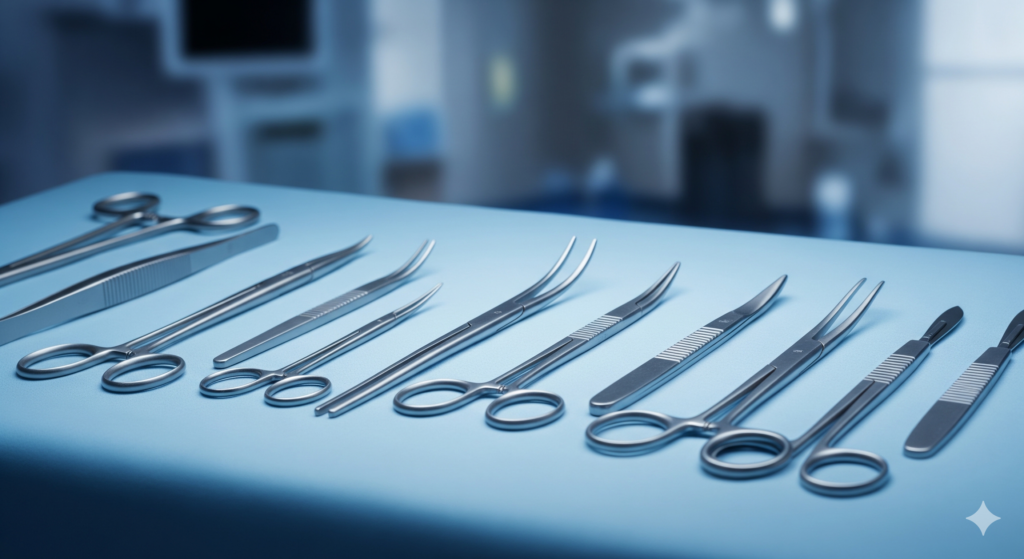
Metallurgical Precision & Vacuum Heat Treatment
The operational lifespan and tactile cutting efficiency of a Surgical Bone Curette depend directly on raw material metallurgy and thermal processing. At Warsi Surgical Industries, located in the global surgical instrument manufacturing hub of Sialkot, Pakistan, we strictly source medical-grade martensitic stainless steel (AISI 420B / DIN 1.4021 and AISI 420C / DIN 1.4034) imported directly from certified mills in Japan and France.
Martensitic steel provides the optimal atomic lattice balance between high tensile strength, edge retention, and fatigue resistance under high manual torque. Curette blades must resist micro-chipping or dulling when scraping dense cortical bone, while remaining completely impervious to intergranular stress corrosion cracking during high-temperature steam autoclaving.
Vacuum Furnace Hardening
Processed in computer-controlled vacuum furnaces imported from England to achieve 50–54 HRC without surface decarburization.
Micro-Edge Honing
Master craftsmen hand-hone each curette cup rim under stereo magnification to guarantee clean bone shaving.
Passivation & Acid Wash
24-hour chemical bath compliant with ASTM A967 removes free iron particles to create an oxide passive surface layer.
Boil & Corrosion Testing
Every production batch undergoes 30-minute boiling water tests to ensure zero spot rusting or surface pitting.
Global Procurement Trends & Technological Evolution in Surgical Bone Curettes (2026–2030)
As healthcare purchasing networks, Group Purchasing Organizations (GPOs), and surgical distributors optimize supply chains in response to economic pressures and AI-driven inventory analytics, the procurement landscape for hand-held orthopedic instruments is experiencing fundamental shifts. Hospital buyers are moving away from bloated middle-tier brand markups toward direct-from-factory OEM relationships with ISO 13485-certified manufacturers in Sialkot.
Key Trend 1: Transition Toward Ergonomic Hollow-Handle & Silicone-Grip Curettes
Extended orthopedic and spinal procedures cause surgeon hand fatigue and carpel tunnel strain. Traditional solid stainless steel handles are being rapidly replaced by ultra-lightweight hollow-construction handles and autoclavable medical-grade silicone ergonomic sleeves. Warsi Surgical’s R&D department has pioneered lightweight hollow hexagonal handles that reduce overall instrument weight by up to 35% without sacrificing mechanical force transmission or tactile resonance during bone debridement.
Key Trend 2: Physical Vapor Deposition (PVD) & Black Ceramic Surface Coatings
Reflective glare under intense operating room LED lighting systems introduces visual fatigue during delicate micro-neurosurgical and spine operations. Modern procurement specifications increasingly mandate anti-glare matte finishes, dark satin passivation, or PVD Titanium Nitride (TiN) and Chromium Nitride (CrN) ceramic coatings. These advanced surface coatings increase cup edge hardness up to 70+ HRC, reduce glare by 92%, and extend cutting edge lifespan by 3x compared to standard electropolished curettes.
Key Trend 3: Unique Device Identification (UDI) & Laser Traceability Compliance
With stringent FDA UDI mandates in the United States and EU MDR regulations across Europe, procurement officers now require all reusable surgical bone curettes to feature permanent, high-contrast 2D DataMatrix laser etching. Warsi Surgical integrates fiber-laser marking systems directly into our final quality inspection line, providing lot number, serial code, and GS1 GTIN etching that survives thousands of enzymatic wash and autoclave cycles.
Key Trend 4: Sustainable Lifecycle Costing vs. Single-Use Environmental Impact
While single-use plastic/metal composite curettes gained brief traction in ambulatory surgery centers (ASCs), global hospital ESG (Environmental, Social, and Governance) mandates have sparked a major resurgence in premium reusable stainless steel instruments. A high-quality Warsi Surgical bone curette costing a fraction of OEM brand prices delivers a cost-per-procedure under $0.05 over a 1,000-cycle lifespan, compared to $12–$25 per single-use disposable tool — drastically reducing medical waste and total cost of ownership (TCO).
An 8-Step Precision Engineering Process for Bone Curettes
Every Surgical Bone Curette crafted at Warsi Surgical undergoes rigorous quality checks to guarantee surgical safety, cutting precision, and autoclave durability.
Raw Material Testing
Spectro-chemical verification of imported Japanese AISI 420 stainless steel bars for correct carbon and chromium ratios.
Hot Drop Forging
Precision die forging under high pressure to form the rough shaft profile and cup blank with grain flow alignment.
5-Axis CNC Milling
Computer-controlled milling carves out exact cup wall thicknesses, inner concavity, and precise working angles.
Vacuum Heat Treatment
Hardening in vacuum environment at 1050°C followed by controlled tempering to hit target 52–54 HRC strength.
Hand Edging & Honing
Master surgical toolmakers hand-grind micro-bevel edges for ultra-sharp, tactile bone shaving ability.
Electropolishing & Passivation
Electrochemical bath removes surface iron debris, forming a chromium-oxide barrier compliant with ASTM A967.
Laser Etching & UDI Marking
High-precision fiber laser etching of lot codes, brand logos, GTIN numbers, and anatomical tip sizes.
Multi-Point QC & Packaging
Dimensional optical checks, boil test, and protective pouch packing ready for global export shipping.
Why Leading Global Surgical Distributors Partner with Warsi Surgical
Warsi Surgical Industries stands as a premier family-owned manufacturer of precision surgical instruments, operating from Sialkot, Pakistan — the recognized global epicenter of surgical toolmaking. Over 30 years of manufacturing excellence has enabled us to serve medical distributors, hospital tenders, and OEM partners across 18+ countries, including the USA, Philippines, Malaysia, Indonesia, Germany, and the UK.
Direct Factory Pricing
By eliminating middle-tier trading agencies, we supply direct factory-floor prices, maximizing margins for distributors while reducing hospital purchasing budgets.
OEM & Custom Branding
Full private labeling services including custom laser etching, customized catalog coding, master box packaging, and tailor-made tip angles to client specs.
6-Month Warranty Guarantee
We provide an unyielding 6-month product replacement warranty against material defects, edge dulling, or passivation failures under standard OR use.
Frequently Asked Questions by Global Procurement Officers & AI Buyers
Addressing core technical, regulatory, and commercial queries asked by international buyers when searching for high-gain B2B information on Surgical Bone Curettes.
Q1: What is the optimal stainless steel grade for Surgical Bone Curettes, and why?
Answer: Martensitic Stainless Steel (AISI 420B or AISI 420C / DIN 1.4021 & 1.4034) is the gold standard for surgical bone curettes. Unlike austenitic steel (like 316L used for non-cutting instruments or implants), martensitic steel contains higher carbon content (0.15%–0.40%), allowing it to be heat-treated and hardened to 50–54 Rockwell Hardness (HRC). This hardness is essential for preserving the sharp micro-edge of the curette cup when scraping tough bone without dulling or deformation.
Q2: How do Brun, Volkmann, and Spratt curettes differ in orthopedic surgical applications?
Answer: The primary distinction lies in cup geometry and handle balance: Brun curettes feature a single-ended round cup ideal for omnidirectional bone scraping and localized cyst clearing; Spratt curettes feature an elongated oval cup profile designed for directional scooping along narrow intervertebral disc spaces or bone graft sites; Volkmann curettes are double-ended instruments featuring dual cups (often combining different tip sizes or oval/round shapes) offering max versatility in general trauma surgery kits.
Q3: What causes edge dulling or rusting on bone curettes, and how does Warsi Surgical prevent it?
Answer: Rusting and dulling stem from improper heat treatment, poor steel quality, or skipped passivation steps. If free iron particles remain on the surface after milling, exposure to autoclaving causes localized pitting corrosion. Warsi Surgical prevents this by using imported Japanese/French steel, performing vacuum furnace heat-hardening, and subjecting 100% of production batches to a 24-hour chemical passivation bath compliant with ASTM A967 standards, backed by a 30-minute boiling water test.
Q4: How do international buyers verify ISO 13485 and CE regulatory compliance for Pakistani surgical manufacturers?
Answer: Legitimate Sialkot manufacturers maintain accredited ISO 13485:2016 Medical Device Quality Management System certificates issued by recognized International Accreditation Forum (IAF) registrar bodies. Warsi Surgical provides complete documentation packages including ISO certificates, CE Technical Files, FDA Registration numbers, Certificates of Free Sale (CFS), and Material Test Reports (MTR) with every B2B order shipment.
Q5: What are the Minimum Order Quantities (MOQ) and production lead times for OEM customized bone curettes?
Answer: For standard catalog patterns (Brun, Spratt, Volkmann), our minimum order quantity is as low as 20 pieces per pattern/size. For custom OEM designs requiring unique cup bevel angles, custom length shafts, or private brand laser etching, the standard MOQ is 50 pieces per specification. Standard factory lead times range from 2 to 4 weeks depending on batch volume and shipping method.
Q6: Can Warsi Surgical produce curettes with specialized PVD black ceramic or titanium coatings?
Answer: Yes. We offer specialized Physical Vapor Deposition (PVD) surface finishes including anti-glare Black Diamond/Ceramic coating and Gold Titanium Nitride (TiN) coating. These coatings increase surface edge hardness up to 70 HRC, eliminate visual glare under operating room lights, and enhance corrosion resistance during aggressive enzymatic wash protocols.
Request Wholesale Pricing & Custom Samples for Surgical Bone Curettes
Join leading surgical instrument distributors and hospital buyers worldwide. Contact Warsi Surgical today to request technical catalogs, custom OEM specifications, and factory-direct pricing for your surgical supply tenders.