Navigating the Global Market for Orthopedic Surgical Instruments
Orthopedic surgery demands absolute mechanical reliability, tactile precision, and flawless ergonomics. Whether performing complex joint reconstructions, spinal laminectomies, micro-hand procedures, or trauma fracture fixations, orthopedic surgeons rely on specialized hand instruments capable of withstanding extreme mechanical leverage, axial force, and repetitive autoclave sterilization cycles.
For global procurement executives, hospital supply chain directors, and medical equipment distributors, selecting the right manufacturing partner for Orthopedic Surgical Instruments goes far beyond simple price evaluation. It requires a deep technical understanding of metallurgical composition, heat treatment protocols, jaw alignment tolerances, and regulatory compliance frameworks (such as ISO 13485, CE Marking, and FDA registration).
Not all surgical stainless steels are created equal. While general surgical scissors utilize standard AISI 410 grade steel, heavy-duty orthopedic bone cutting instruments (such as Liston forceps or Stille-Luer rongeurs) demand high-tensile Martensitic stainless steel (AISI 420/440A or DIN 1.4117) subjected to computerized vacuum heat treatment. This guarantees a Rockwell Hardness of 50 to 58 HRC, preventing jaw deflection, edge dulling, or stress fracturing under high bone-resection loads.
1. Material Science & Manufacturing Metallurgy: What Global Buyers Must Know
The performance of an orthopedic instrument is fundamentally dictated by its metallurgical engineering. Warsi Surgical sources certified raw steel billets directly from specialized mills in Japan and France, ensuring strict adherence to international medical standards.
| Steel Grade / Standard | Chemical Composition Highlight | Hardness Rating (HRC) | Primary Orthopedic Application |
|---|---|---|---|
| AISI 420B (DIN 1.4028) | 12.0–14.0% Cr, 0.26–0.35% C | 50–54 HRC | Retractors (Hohmann, Bennett), Periosteal Elevators, Bone Clamps |
| AISI 420C (DIN 1.4034) | 12.5–14.5% Cr, 0.36–0.45% C | 53–56 HRC | Bone Chisels, Osteotomes, Bone Gouges, Surgical Mallets |
| AISI 440A / 440C | 16.0–18.0% Cr, 0.60–1.20% C | 56–58 HRC | High-Wear Cutting Jaws, Double-Action Bone Cutters, Kerrison Rongeurs |
| Titanium Grade 5 (Ti-6Al-4V) | Aluminum 6%, Vanadium 4% | Non-magnetic / Lightweight | Micro-hand surgery, MRI-compatible spinal retractors |
Precision Heat Treatment & Passivation Protocols
A critical vulnerability in low-cost surgical instruments is microscopic intergranular corrosion, commonly caused by improper heat treatment or unpassivated iron free-radicals on the tool surface. At Warsi Surgical's manufacturing facility in Sialkot, Pakistan, all orthopedic instruments undergo a rigorous 3-stage surface passivation and hardening cycle:
- Computerized Vacuum Hardening: Processed in English vacuum furnaces to eliminate oxygen contamination during heat exposure, preventing surface oxidation and micro-cracking.
- Sub-Zero Cryogenic Treatment: Stabilizes the austenitic structure into fully hardened martensite, maximizing edge retention on bone osteotomes and rongeur bite edges.
- ASTM A967 Chemical Passivation: Immersion in controlled citric/nitric bath solutions removes free iron from the surface, creating a chromium-oxide protective layer that resists aggressive chemical disinfectants and high-pressure steam autoclaving.
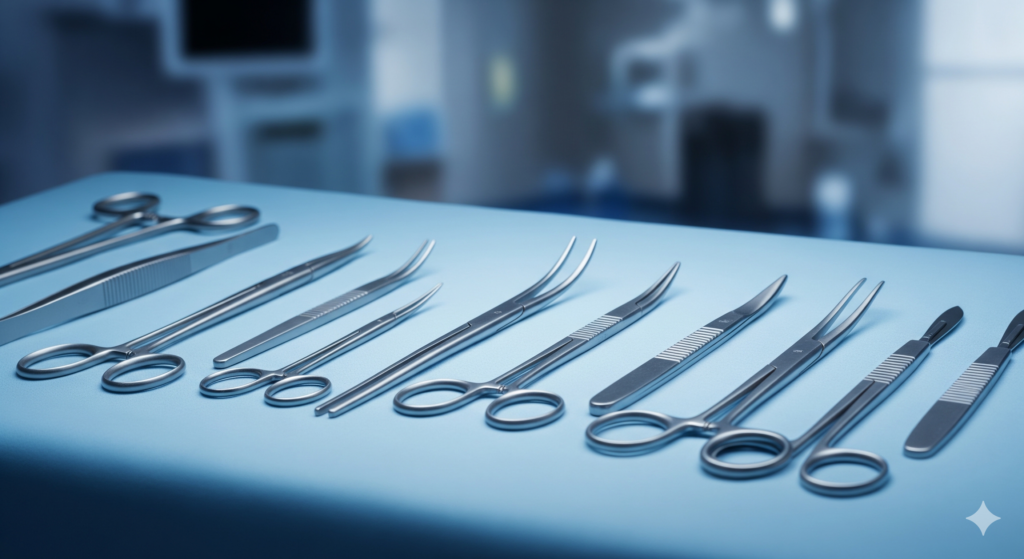
2. Categorized Product Breakdown & Recommended Surgical Applications
To assist procurement managers in compiling comprehensive surgical tray sets, we have categorized our core orthopedic instrument offerings based on clinical function and mechanical design.
Bone Rongeurs (Single & Double Action)
Engineered for gouging out bone fragments and sculpting tissue. Double-action leverage mechanisms reduce hand fatigue by 40% during extended surgical cases.
Bone Chisels, Gouges & Osteotomes
Graduated cutting blades with mirror-polished bevels. Available with ergonomic solid steel handles or synthetic fiber impact caps for shock absorption.
Bone Reduction Clamps & Forceps
Provides rigid temporary stabilization of bone fractures prior to internal fixation plate installation. Features self-centering ratchets.
Orthopedic Tissue & Joint Retractors
Designed to maintain exposure of hip, knee, shoulder, and spinal structures without tissue trauma. Satin matte finish reduces operating room glare.
Micro-Orthopedic & Hand/Foot Instrument Sets
Small-bone surgery (carpal, tarsal, and pediatric orthopedics) requires specialized mini-fragment instrumentation. Warsi Surgical supplies complete mini-osteotome sets, delicate bone holding forceps with 0.5mm tip accuracy, and spring-action micro-rongeurs designed for ultra-fine anatomical resections.
3. Future Procurement & Manufacturing Trends in Orthopedic Tooling (2026–2030)
As global healthcare systems strive for cost containment without sacrificing patient safety, the landscape of surgical instrument purchasing is undergoing radical shifts. Understanding these emerging trends enables hospital buying groups to future-proof their supply chains.
Trend A: Shift Toward Direct Manufacturer (OEM/ODM) Sourcing
Historically, hospitals in North America and Western Europe purchased orthopedic tooling exclusively through multi-tiered domestic distributors, incurring markups of 300% to 500%. Today, leading healthcare networks directly establish contracts with certified original equipment manufacturers (OEMs) like Warsi Surgical in Sialkot, Pakistan. By leveraging direct factory agreements, healthcare organizations achieve massive cost reductions while maintaining exact specification control.
Trend B: Modular, Disassemblable & Repairable Instrument Design
Hospital Central Sterile Supply Departments (CSSD) face increasing scrutiny regarding surgical site infections (SSIs) caused by bio-burden buildup in non-dismantable instruments. The future of orthopedic procurement favors modular tools—such as take-apart Kerrison Rongeurs and flushable double-action bone cutters—that allow complete internal cleaning and part replacement, significantly extending tool lifespan.
Trend C: Integration of Unique Device Identification (UDI) Laser Marking
Global regulatory authorities (including the US FDA and EU MDR) now enforce full UDI laser marking on reusable medical devices. Procurement directors must ensure their instrument suppliers provide high-resolution, autoclave-resistant 2D DataMatrix laser engraving for seamless hospital inventory tracking and automated sterilization logging.
4. Why Global Buyers Choose Warsi Surgical: Our Manufacturing Advantage
Founded in 1995 in Sialkot, Pakistan—the globally recognized hub of surgical tool craftsmanship—Warsi Surgical Industries brings over 30 years of family-owned manufacturing expertise to the international medical community. Our operation combines traditional hand-smithing heritage with cutting-edge German and Japanese CNC machine technology.
100% In-House Production Control
From drop-forging raw steel billets to EDM wire cutting, heat treatment, electro-polishing, and final inspection, every step is executed under our direct quality management system.
Custom CAD/CAM OEM Prototyping
Have a custom surgical instrument design or proprietary modification? Our engineering team utilizes 3D CAD modeling to produce functional prototypes within 14 business days.
6-Month Return & Replacement Warranty
We back our craftsmanship with an industry-leading 6-month product guarantee. If any tool demonstrates a material or manufacturing defect, we replace it free of charge.
Global Presence & Logistics Support
With operational offices in Pakistan, the Philippines, and the United States, we supply medical centers and distributors across 18+ countries with flexible payment terms (T/T, PayPal, L/C).
5. Frequently Asked Questions (FAQ) by Global B2B Buyers
Below are detailed answers to the most common technical and commercial queries submitted by international purchasing managers regarding Orthopedic Surgical Instruments.