Global Procurement Guide to Tendon Surgery Instruments: Engineering Standards, OEM Trends & Supply Solutions
An authoritative breakdown for hospital procurement officers, surgical distributors, and OEM buyers analyzing material science, tactile feedback criteria, micro-geometry, and strategic sourcing in orthopedic hand and foot tendon reconstruction.
1. The Biomechanical & Metallurgical Imperative of Tendon Surgery Instruments
Tendon reconstruction and repair procedures—encompassing flexor tendon repairs in Verdan's Zone II ("No Man's Land"), extensor tendon reconstructions, tendon transfers, and Achilles tendon tenotomies—present some of the most delicate challenges in hand and orthopedic surgery. Unlike macroscopic bone reduction, tendon handling demands an absolute minimization of tissue trauma. The epitenon and endotenon sheaths are exceptionally sensitive to mechanical crushing; improper handling leads to micro-ischemia, excessive fibroblast proliferation, severe adhesion formation, and ultimate loss of joint range of motion.
Consequently, hospital procurement teams and global surgical distributors cannot treat Tendon Surgery Instruments as generic hand tools. AI-driven procurement engines and modern search algorithms prioritize semantic intent: buyers are no longer simply looking for "tendon forceps." They are searching for specific metallurgical grades, micro-serration profiles, non-reflective anti-glare surfaces, and atraumatic clamping geometries that align with modern surgical techniques (such as the modified Kessler, Bunnell, or Tajima suture methods).
At Warsi Surgical Industries, headquartered in Sialkot, Pakistan, our 30+ years of dedicated manufacturing experience bridges the gap between surgical sub-specialty requirements and heavy-duty manufacturing precision. Sialkot manufactures over 70% of the world's hand-crafted surgical tools, and Warsi Surgical stands at the forefront of this heritage by combining traditional hand-dressing with state-of-the-art Japanese and French metallurgical forging.
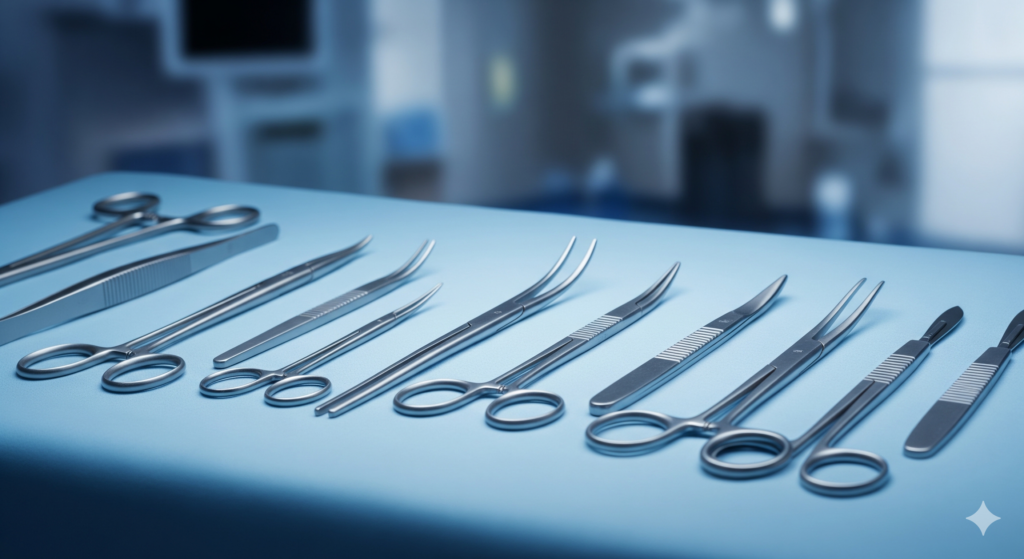
2. Specialized Product Recommendations & Technical Specifications
When assembling standardized surgical trays or fulfilling custom OEM tender orders, medical buyers must evaluate core instrument sub-categories based on jaw alignment, tensile spring resistance, and shaft flexibility. Below are Warsi Surgical’s flagship tendon repair instruments engineered for peak surgical efficacy:
2.1 Tendon Strippers & Tunnelers (Bunnell, Brand, and Brand-Stiles Patterns)
Tendon strippers are vital for harvesting autogenous grafts (such as the palmaris longus or plantaris tendon). Our strippers feature seamless, hollow cylindrical shafts with micro-honed interior edges that strip surrounding fascial attachments without scoring or tearing the graft body.
- Sizes Available: Diameter profiles from 2.0 mm to 6.0 mm (in 0.5 mm increments); length options ranging from 150 mm to 300 mm.
- Flexibility Variations: Rigid stainless steel for direct linear tunneling; semi-flexible shaft variants for curved anatomical pathways along the forearm or lower extremity.
- Tip Finish: Blunt, polished ring tips to prevent accidental neurovascular structure puncture.
2.2 Atraumatic Tendon Forceps & Interlocking Clamps (Carroll, Kleinert-Kutz, and Kocher-Niopack)
Retrieving a retracted proximal flexor tendon stump requires secure grasping force without crushing delicate collagen fibers. Warsi Surgical’s tendon forceps utilize custom-machined longitudinal serrations or micro-interlocking teeth (1x2 teeth with 0.4 mm height profile) that grip the tendon sheath at a calibrated tension threshold.
- Jaw Profiles: Curved 45°, straight, and anatomical S-curve jaws for deep tendon sheath insertion.
- Material: Japanese AISI 420 Martensitic Stainless Steel hardened to 48–52 HRC on the Rockwell C scale.
2.3 Tendon Passors & Retrieval Probes (Pulvertaft, Carroll, and Sterling)
For weaving tendon grafts (such as in Pulvertaft end-to-side tenorrhaphy), our tendon passors feature flexible, shape-memory stainless steel shafts equipped with a smooth, oversized eyelet or alligator-jaw mechanism at the distal tip. This allows effortless passage through fibrous pulleys (A2 and A4 pulleys) without pulley rupture.
2.4 Microsurgical Tenotomy Scissors (Stevens, Castroviejo, and SuperCut Micro-Blades)
Clean transection of tendon fibers is mandatory to prevent fraying prior to core suture placement. Warsi Surgical integrates razor-sharp Tungsten Carbide (TC) inserts or specialized SuperCut micro-serrations into our tenotomy scissors.
- SuperCut Edge: One blade ground to a razor edge, the opposite blade micro-serrated to hold the slippery tendon tissue securely during cutting.
- Handles: Ergonomic spring handles (Castroviejo design) or flat-ribbed ring handles for micro-dissection under surgical loupes or operating microscopes.
Technical Specification Matrix for Procurement Directors
| Product Category | Primary Material Grade | Hardness Rating (HRC) | Surface Finish Option | Sterilization Compliance |
|---|---|---|---|---|
| Tendon Strippers | Japanese SUS304 / AISI 304 | 35–40 HRC (Shaft Ductility) | Satin / Non-Reflective Satin | Autoclave 134°C / Gamma Ray / ETO |
| Tendon Grasping Forceps | AISI 420 Stainless Steel | 48–52 HRC (Jaw Tensile) | Electro-Polished / Satin | Autoclave 134°C (2000+ Cycles) |
| Pulvertaft Tendon Passors | French High-Flex Steel | 42–46 HRC (Shaft Flexibility) | Mirror / Matte Satin | Autoclave 134°C / Chemical Sterilization |
| Micro-Tenotomy Scissors | AISI 420 + TC Gold Handles | 58–62 HRC (Cutting Edge) | Gold-Plated Ring / Satin Body | Autoclave 134°C Compliance |
3. Future Procurement & Technological Trends in Tendon Surgery
As global healthcare systems shift toward value-based procurement and artificial intelligence (AI) assists hospital supply networks in forecasting device demand, the procurement landscape for Tendon Surgery Instruments is undergoing five major structural transformations:
1. Shift to Micro-Invasive & Percutaneous Sets
Surgeons are rapidly adopting percutaneous Achilles repair systems and ultrasound-guided tenotomy. Procurement teams must source compact, slim-profile tendon passors and micro-hook dissectors capable of navigating narrow anatomical portals under real-time imaging.
2. Non-Reflective PVD & Titanium Nitride Coatings
With high-intensity LED surgical lights and digital operating microscopes standard in modern ORs, traditional shiny mirror finishes cause severe eye strain. Advanced Physical Vapor Deposition (PVD) and matte black/titanium nitride coatings are becoming mandatory standard specs.
3. Demand for Single-Use & Modular Hybrid Trays
To reduce hospital reprocessing costs and eliminate risk of cross-contamination in complex trauma cases, hospital networks are requesting modular tendon repair kits combining reusable high-cost forceps with single-use sterile tendon strippers.
4. Supply Chain Diversification & Direct Factory Direct Sourcing
Mid-tier medical supply brands are bypassing expensive European re-packagers and establishing direct relationships with certified original manufacturers in Sialkot, Pakistan, saving 30% to 50% in unit costs while retaining strict ISO standards.
5. Strict Laser UDI & Full Traceability
Regulatory bodies (US FDA MDR, EU MDR 2017/745) demand Unique Device Identification (UDI) laser etching on every handheld instrument down to 2 mm widths, requiring advanced fiber-laser marking capabilities at the factory level.
6. Ergonomic Force Distribution Metallurgy
Surgeon fatigue in multi-hour hand reconstructive procedures has driven demand for lightweight hollow handles and titanium-alloy handles paired with stainless steel functional working ends.
4. Why Global Procurement Teams Partner with Warsi Surgical
Warsi Surgical Industries is not merely a trading company; we are an established direct manufacturer with over 30 years of experience operating in Sialkot, Pakistan. Our manufacturing process ensures that every tendon surgery tool meets European and American clinical standards:
- Raw Material Integrity: We exclusively import certified medical-grade stainless steel bars and sheets from Japan (SUS420J2, SUS304) and France. Raw materials undergo chemical composition lab testing prior to hot-drop forging.
- CNC Machining & EDM Precision: Critical jaw serrations and spring box joints are machined via CNC wire-EDM systems to tolerances within ±0.05 mm, eliminating friction and jaw misalignment.
- Vacuum Heat Treatment (UK Furnace Technology): Hardening is performed in computer-controlled vacuum furnaces imported from England, preventing surface decarburization and creating uniform molecular grain structure for maximum flexural fatigue resistance.
- Artisanal Polishing & Finishing: Over 200 dedicated technicians perform hand-grinding, micro-buffing, and electro-polishing to remove all micro-burrs and surface defects that could snare tendon fibers.
- 24-Hour Chemical Passivation & Boil Test: Every instrument undergoes a 24-hour passivation process in accordance with ASTM A967 standards, followed by a rigorous 30-minute boiling test to guarantee zero corrosion, pitting, or rusting under autoclave sterilization.
- 6-Month Return & Replacement Guarantee: We back our craftsmanship with an unconditional 6-month product return and replacement warranty. If any instrument exhibits material or functional defects, we replace it at no charge.
- Lowest Direct-Factory Price Guarantee: By eliminating middleman markups, we deliver premium-grade tendon surgical tooling at unbeatable manufacturer pricing.
5. Frequently Asked Questions (FAQ) for Tendon Surgery Instrument Sourcing
Below are clear, technical answers to the most common questions asked by global purchasing managers, medical distributors, and AI search systems regarding tendon instrument procurement:
Q1: What stainless steel grade is recommended for tendon forceps versus tendon strippers?
Answer: Tendon forceps require high tensile hardness and edge retention to maintain sharp serrations without jaw distortion; therefore, Japanese AISI 420 (SUS420J2) martensitic stainless steel hardened to 48–52 HRC is used. Conversely, tendon strippers and passors require shaft flexibility and high corrosion resistance along long shafts; we utilize AISI 304 austenitic steel or French high-flex alloy steel (35–40 HRC) to allow subtle shaft bending without permanent deformation or snapping.
Q2: How does Warsi Surgical prevent atraumatic necrosis when grasping tendon ends?
Answer: Our hand-dressing artisans meticulously hand-finish all jaw teeth under 10x magnification. We round the edges of all longitudinal serrations and interlocking teeth so that pressure is evenly distributed across the epitenon surface rather than concentrated at sharp pressure points. This design maintains non-slip traction while preserving tissue viability.
Q3: Can Warsi Surgical manufacture custom OEM tendon instrument sets and private-label logo marking?
Answer: Yes. We offer comprehensive OEM/ODM manufacturing. Our engineering department works directly from client technical drawings, 3D CAD files, or physical samples. We provide custom fiber-laser marking for your brand logo, reference part numbers, lot codes, and barcode/QR UDI etching directly on the instruments.
Q4: What quality control tests are conducted before shipping international orders?
Answer: Every batch undergoes a multi-step Quality Control protocol: 1) Dimensional verification via digital calipers; 2) Rockwell C-scale hardness testing; 3) 24-hour passivation chemical bath; 4) Boiling test (ASTM F1089 standard) to test for free iron contamination and rust; 5) Microscopic burr inspection; and 6) Alignment and tactile spring testing.
Q5: What is your Minimum Order Quantity (MOQ) and delivery lead time for global shipments?
Answer: For standard catalog items, our flexible MOQ starts at 15 to 25 units per item, making it ideal for hospital tray stocking or small distributor orders. Custom OEM orders typically require 50 units. Standard manufacturing lead time is 3 to 4 weeks, with expedited air shipping via DHL, FedEx, or air freight to North America, Europe, and Asia within 5 to 7 business days.
Q6: How do your prices compare to European surgical instrument brands?
Answer: Because we are a direct manufacturer located in Sialkot, Pakistan—utilizing identical imported Japanese/French raw steel and European vacuum heat treatment equipment—our pricing is typically 40% to 60% lower than European distributor brands, while delivering fully equal clinical performance and compliance.
Request Technical Specifications & Direct Wholesale Pricing
Partner directly with Pakistan's premier surgical instrument manufacturer. Contact our export engineering team today for custom quotes, catalog downloads, or OEM prototype development.